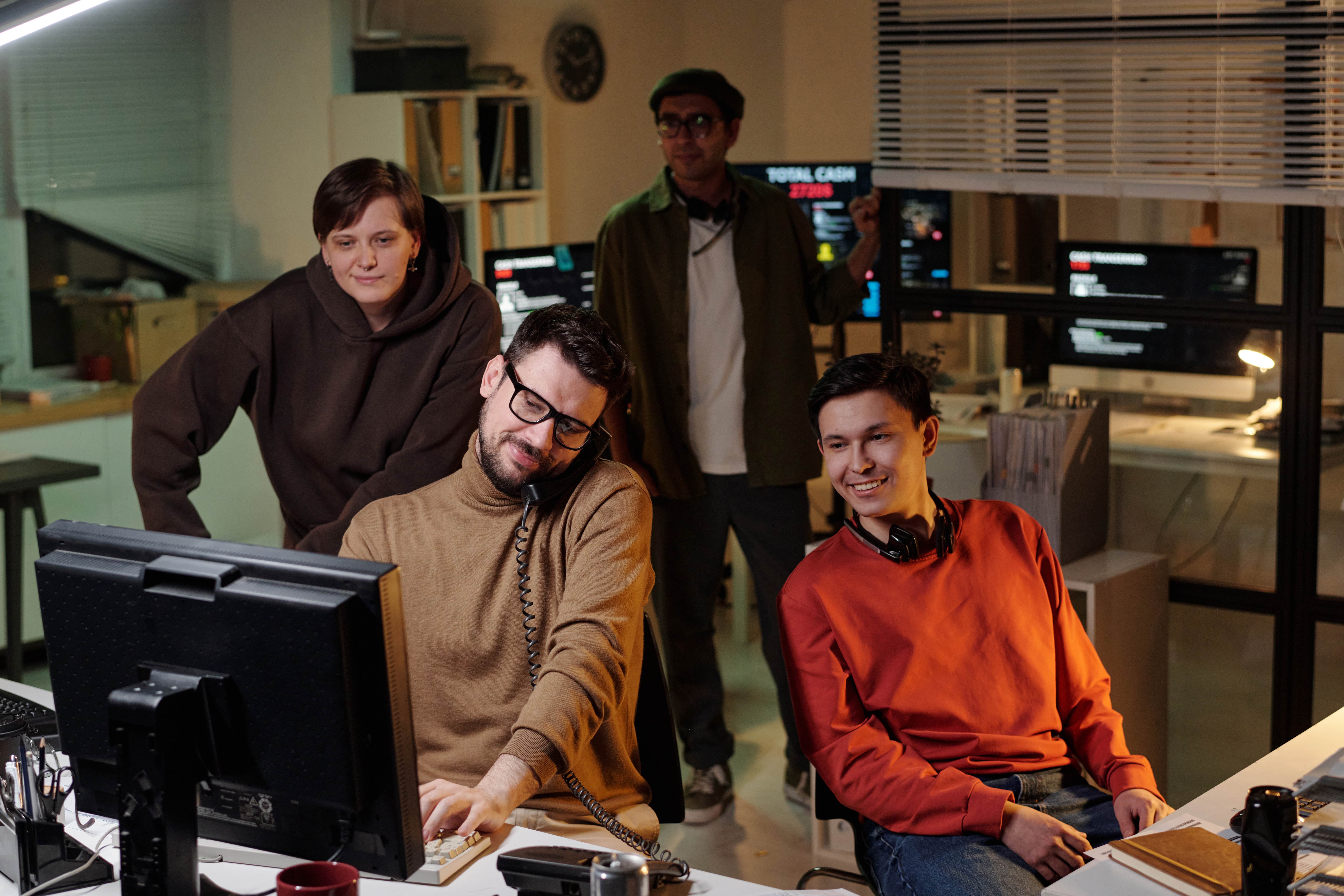

Ask most agency owners what makes a great post-production team, and you'll probably hear the same answers.
Talented editors.
Strong storytelling.
Creative motion graphics.
Beautiful color grading.
Those things absolutely matter. They're what clients see when the project is finished.
But they're not what allows agencies to deliver dozens—or even hundreds—of projects every month without sacrificing quality.
Behind every consistently delivered project is something clients rarely think about: the back-end editing process.
It's the operational side of post-production that keeps projects moving from raw footage to final delivery. It's how files are organized, how reviews are managed, how revisions are tracked, how quality is maintained, and how deliverables reach clients on time.
The irony is that the better a back-end editing process becomes, the less anyone notices it.
Projects simply move.
Editors stay focused.
Clients receive work when they expect it.
The process becomes invisible.
That's exactly why the best agencies invest so heavily in it.
Back-end editing is often misunderstood because it isn't a service clients directly see.
When people hear "video editing," they usually picture someone sitting in Adobe Premiere Pro or DaVinci Resolve, trimming clips and adding transitions. While that's certainly part of the work, it's only one piece of a much larger production system.
Back-end editing refers to everything that supports the editing process before, during, and after the creative work happens. It includes the operational workflows that allow editors to spend more time editing and less time solving preventable production issues.
A strong back-end editing process typically includes:
None of these tasks appear in a showreel.
Yet together, they determine how efficiently an agency can produce content.
As agencies grow, these operational details become increasingly important because every new project introduces additional complexity. More clients mean more stakeholders, more deliverables, more revisions, and more opportunities for production to slow down.
Without a structured back-end editing process, even highly talented editors eventually become overwhelmed—not because they can't edit quickly, but because too much of their time is spent managing everything surrounding the edit.
Operational problems rarely arrive all at once.
Instead, they build gradually until the team accepts them as "just part of the job."
An editor spends ten minutes looking for missing assets.
A project manager follows up on feedback for the third time.
A client requests another version because the wrong file was exported.
A motion graphics template can't be located, so it's rebuilt from scratch.
None of these situations seem significant on their own.
But when they happen across dozens of projects every week, they quietly consume hundreds of production hours every year.
Eventually, agency leaders begin asking familiar questions.
"Why are projects taking longer than they used to?"
"Why do we always seem busy?"
"Why can't we increase output even after hiring more editors?"
The answer often isn't editing.
It's the lack of a scalable back-end editing process.
When production systems depend on memory instead of documented workflows, every new project becomes harder to manage than the last.
Growth doesn't simply add more work.
It adds more operational complexity.
Many agencies unknowingly confuse editing with operating an editing department.
Editing is a creative skill.
Running an editing operation is a business function.
One focuses on producing exceptional creative work.
The other focuses on ensuring exceptional creative work can be delivered consistently, regardless of production volume.
This distinction becomes critical as agencies grow.
An agency producing ten videos each month can often rely on informal communication, shared knowledge, and flexible processes.
An agency producing one hundred videos each month cannot.
At that scale, production requires systems.
Editors need standardized project setups.
Creative briefs need to contain consistent information.
Review processes need clear ownership.
Assets need to be organized before production begins.
Delivery procedures need to be repeatable.
Without these operational standards, production becomes increasingly dependent on individual effort instead of organizational capability.
The agency isn't scaling.
Its people are simply working harder.
One of the biggest misconceptions in post-production is that scaling requires more editors.
While increasing headcount can improve capacity, it rarely fixes inefficient operations.
Imagine hiring five additional editors into a production environment where project files are inconsistently organized, review feedback arrives through multiple platforms, approval processes vary between clients, and every project follows a different workflow.
Those new editors inherit the same operational problems as everyone else.
Instead of increasing efficiency, the agency simply creates more people navigating the same bottlenecks.
The agencies that scale most effectively take a different approach.
Before expanding their teams, they improve the systems supporting those teams.
They standardize how work enters production.
They define how projects move through editing.
They establish consistent review workflows.
They document quality standards.
They simplify delivery procedures.
Only then do they increase production capacity.
Because scaling a strong system is always easier than scaling a disorganized one.
When agencies think about post-production, the conversation usually revolves around speed.
Can we edit faster?
Can we reduce turnaround times?
Can we take on more projects?
While those are important questions, they're only part of the picture.
A strong back-end editing process doesn't just improve efficiency—it protects the entire business.
Every delayed approval, misplaced file, duplicate export, or unnecessary revision carries a cost. It consumes production hours, disrupts project schedules, and pulls creative teams away from higher-value work. These costs rarely appear as a single line item on a financial report, but they accumulate with every project an agency delivers.
As client volume increases, those small inefficiencies become increasingly expensive.
An extra fifteen minutes spent searching for files may not seem significant on one project. Across hundreds of deliverables each month, however, those minutes translate into lost production capacity, delayed launches, and additional labor costs that quietly reduce profitability.
The strongest agencies understand this. They don't view back-end editing as administrative work—they see it as operational infrastructure that protects delivery, profitability, and client relationships.
One of the biggest misconceptions in agency operations is that clients only evaluate the creative work.
In reality, clients experience your workflow long before they evaluate the final video.
They notice how quickly your team responds to feedback. They notice whether revisions are implemented accurately. They notice if the correct versions arrive on time, whether file requests are handled efficiently, and whether production feels organized from beginning to end.
A smooth production experience creates confidence.
Clients may never ask how your projects are organized internally, but they can immediately tell when your operation is well managed. Deadlines feel predictable. Communication feels structured. Deliverables arrive consistently. The agency appears reliable—not because of luck, but because its systems support that consistency.
On the other hand, operational issues are difficult to hide. Missing assets, delayed revisions, inconsistent versioning, and last-minute production issues all become part of the client experience, even if the creative work itself is excellent.
For growing agencies, reliability often becomes just as valuable as creativity.
As agencies grow, production becomes more collaborative.
Editors, motion designers, project managers, account managers, and clients all contribute to the same project. Without shared standards, every new person introduces a slightly different way of working.
One editor names files differently.
Another stores assets in a separate folder.
A freelancer uses their own review process.
A project manager tracks revisions in spreadsheets while another relies on email.
None of these decisions are necessarily wrong, but together they create inconsistency. Over time, inconsistency slows production because every project requires additional clarification before work can move forward.
The agencies that scale successfully recognize this early.
Instead of allowing each project to develop its own process, they build standardized back-end editing systems that every team member follows. Creative briefs follow the same structure. Folder hierarchies remain consistent across clients. Review cycles are documented. Quality assurance happens before delivery, not after. Version control is managed systematically rather than manually.
Standardization isn't about removing flexibility.
It's about creating enough consistency that creative teams can focus on solving creative challenges instead of operational ones.
Modern agencies have access to an impressive range of production tools.
Cloud storage platforms make collaboration easier. Project management software keeps tasks organized. Review tools simplify feedback. AI-powered editing features automate repetitive work and accelerate production.
These technologies can significantly improve efficiency.
However, technology only amplifies the quality of the system behind it.
An organized workflow becomes faster with better tools.
A disorganized workflow simply becomes a faster way to create confusion.
Introducing new software without improving underlying processes often creates additional complexity rather than reducing it. Teams spend time learning new platforms while still relying on inconsistent review methods, unclear project ownership, or fragmented communication.
The most effective agencies don't begin with technology.
They begin with process.
Once workflows are clearly defined and responsibilities are established, technology becomes an accelerator rather than a solution searching for a problem.
This is one of the biggest reasons why mature agencies continue improving operational performance even as production demands increase.
Every agency reaches a point where growth begins to expose weaknesses in its production process.
A few additional clients may seem manageable at first, but every new project introduces more revisions, more deliverables, more stakeholders, and more deadlines.
Without a structured back-end editing process, complexity grows faster than production capacity.
Eventually, editors spend more time switching between projects than completing them. Project managers become full-time coordinators. Creative leads answer operational questions instead of leading creative work. The agency appears busy, but output no longer grows at the same pace.
This is often mistaken for a staffing problem.
In reality, it's usually a systems problem.
Strong back-end editing allows agencies to absorb higher production volumes without creating unnecessary operational friction. Projects move through predictable stages. Team members know exactly where work belongs. Feedback is easier to manage. Quality becomes more consistent because every project follows the same production standards.
The result isn't simply faster editing.
It's a production operation capable of supporting long-term growth.
The agencies that consistently grow aren't necessarily the ones with the largest production teams.
They're the ones that have built a production system capable of handling growth.
As client expectations continue to evolve, agencies are being asked to produce more content than ever before. A single campaign can require long-form videos, short-form social clips, paid advertising variations, platform-specific edits, subtitles, localized versions, and multiple aspect ratios—all delivered within increasingly compressed timelines.
Creative quality is no longer the only competitive advantage.
Execution has become one too.
Agencies that can consistently deliver projects on time, maintain quality across every asset, and scale production without overwhelming their teams are creating an advantage that's difficult for competitors to replicate.
The difference often comes down to their back-end editing process.
A mature back-end editing operation creates predictability. It allows agencies to onboard new clients with confidence, absorb larger workloads without sacrificing quality, and maintain consistent delivery even during their busiest periods. Instead of relying on individual effort to keep projects moving, they rely on documented systems that make production repeatable.
This operational maturity becomes increasingly valuable as agencies grow. It allows leadership to forecast production capacity more accurately, improve resource planning, and pursue new business opportunities without constantly worrying whether the production team can keep up.
In many ways, a strong back-end editing process becomes an extension of the agency's reputation. Clients trust agencies that consistently deliver because reliability builds confidence, and confidence creates long-term partnerships.
Building a mature back-end editing operation internally takes time.
It requires experienced editors, documented workflows, quality assurance standards, production management, asset organization, and ongoing operational improvements. For many agencies, maintaining all of those systems while continuing to grow becomes increasingly difficult.
That's why more agencies are partnering with specialized post-production teams.
The goal isn't simply to outsource editing.
It's to strengthen the operational foundation behind content production.
A dedicated back-end editing partner becomes an extension of the agency's existing workflow, supporting everything from media organization and project setup to review management, quality control, versioning, formatting, and final delivery.
This allows internal creative teams to stay focused on creative direction, client relationships, and campaign strategy while production continues moving efficiently behind the scenes.
Rather than expanding headcount every time demand increases, agencies gain flexible production capacity supported by experienced specialists and proven systems.
The result is a more scalable business model that grows without introducing unnecessary operational complexity.
At Razor Post, we believe great editing is only part of great post-production.
The systems behind the edit matter just as much.
That's why we don't simply deliver finished videos. We help agencies build stronger back-end editing operations that improve consistency, reduce production bottlenecks, and create the capacity needed to support long-term growth.
Our team integrates directly into existing production workflows, providing structured support for media organization, review management, quality control, version control, multi-platform formatting, asset delivery, and ongoing post-production operations.
Instead of becoming another vendor, we become an extension of your production team.
Whether you're managing a growing agency, supporting an in-house marketing department, or scaling client work across multiple brands, our goal is to help you create a back-end editing system that supports your business—not slows it down.
Because the agencies that scale the furthest aren't just producing great content.
They're building operational systems that allow great content to be delivered consistently, efficiently, and at scale.
Back-end editing refers to the operational processes that support video editing and post-production. It includes media organization, project setup, review workflows, quality assurance, version control, multi-platform formatting, file delivery, and asset management. These systems help agencies produce content more efficiently and consistently.
As agencies grow, production becomes more complex. A strong back-end editing process helps reduce operational bottlenecks, improve turnaround times, maintain consistent quality, and increase production capacity without relying solely on additional headcount.
Back-end editing standardizes the way projects move through production. By improving organization, communication, review processes, and quality control, agencies can manage larger workloads more efficiently while maintaining predictable delivery.
Yes. Video editing focuses on the creative process of transforming raw footage into finished content. Back-end editing focuses on the operational systems that support that creative work, making production more organized, repeatable, and scalable.
Many growing agencies choose to partner with specialized post-production teams because it gives them access to scalable production systems, experienced editors, and operational support without significantly increasing internal overhead. A dedicated back-end editing partner can strengthen production workflows while allowing internal teams to stay focused on strategy and client relationships.
The quality of your edits matters.
But the quality of the system behind those edits often determines how far your agency can grow.
If projects are becoming harder to manage, revision cycles continue to grow, or your production team is spending more time coordinating work than creating it, it may be time to evaluate your back-end editing process.
Book a free Content Strategy Call with Razor Post.
We'll walk through your current production workflow, identify operational gaps, and share practical recommendations to help your agency improve efficiency, increase production capacity, and build a back-end editing system designed for long-term growth.
Whether you're preparing for your next stage of growth or simply looking for a more efficient way to deliver client work, we're here to help you build a stronger production operation.